
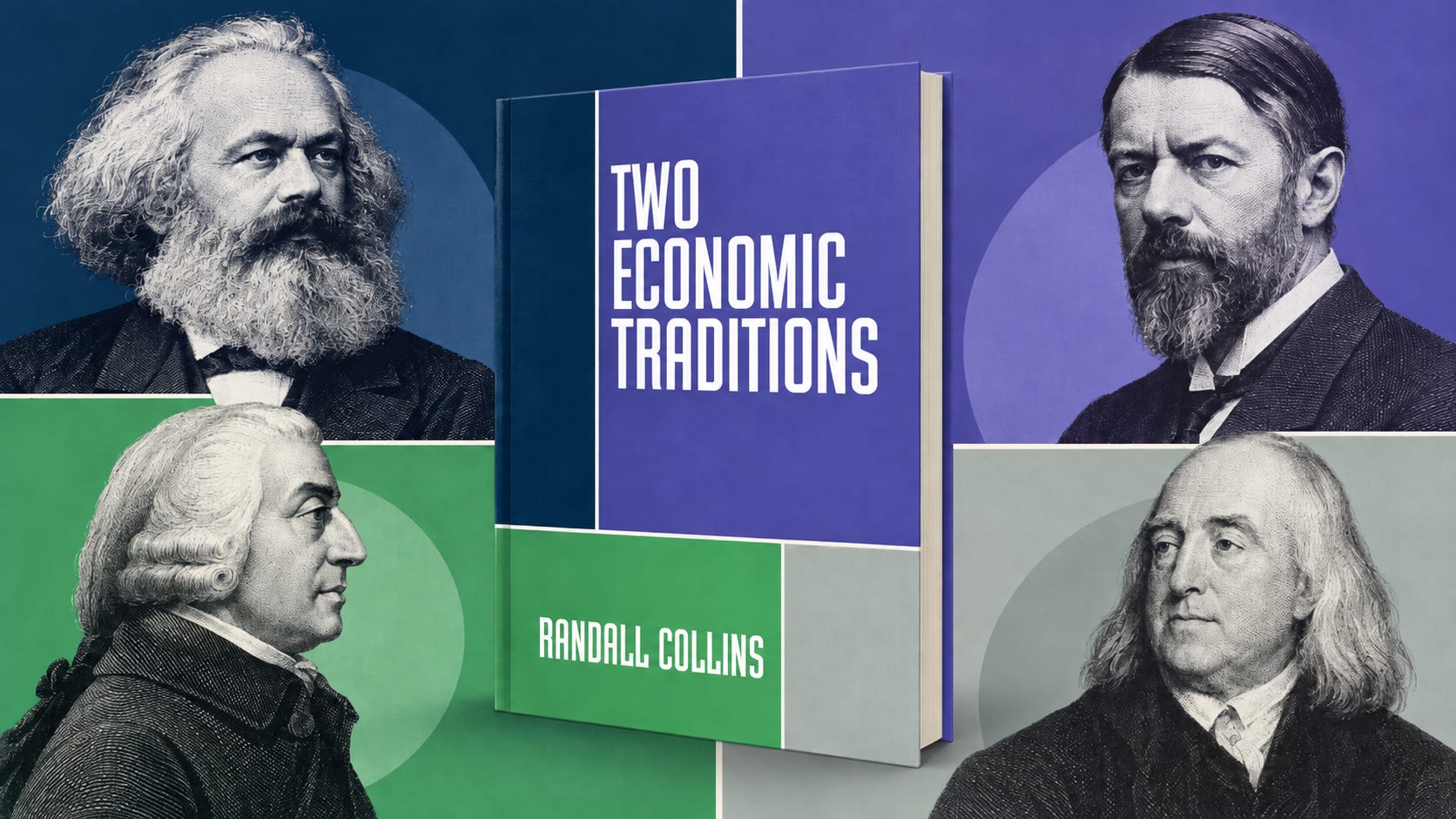
I often use Randall Collins’ book Four Sociological Traditions in my class discussions and in my own work on the history of economic ideas. Collins’ discussion of economics as the first social science is instructive about how disciplines become autonomous from other fields. Economics emerged earlier than the other social sciences as an independent discipline, in his account, because states had practical reasons to collect information about taxation, trade, population, and public finance. Mercantilism created a body of empirical and administrative knowledge, and later writers, starting with William Petty (he cites François Quesnay and then Adam Smith rather than Petty), transformed these concerns into a more systematic intellectual discipline. Economics was able to establish itself institutionally before sociology because it had both practical applications and a relatively clear object of study.
Collins then shows how economics became increasingly professionalized during the nineteenth century. There is an extensive literature on that (on the American case see Coats, 1988). Classical political economy initially developed partly outside the universities, especially in Britain. In Germany, however, economics became more firmly tied to state administration and university training (on the German Historical School see Kurz, 2016). Later, marginalism and neoclassical economics helped turn economics into a more abstract and specialized academic discipline. Collins’s broader point is that the content of economic theory cannot be separated entirely from the institutional settings in which economists worked.
For Collins, ideas are produced inside social networks and institutions. Intellectual change occurs when institutional spaces open up, when new professional roles become available, and when communities of scholars compete over problems, methods, and prestige. In that sense, the rise of the social sciences – economics and, more interestingly, sociology itself – is a sociological phenomenon. The community makes the discipline.
Object of analysis vs method of analysis
Collins sees scholarly traditions that cannot be reduced to mere sets of doctrines associated with famous thinkers. These are enduring lines of intellectual competition generated by particular networks of scholars, the institutions to which they were connected, and the problems they studied. They are parallel paradigms in Thomas Kuhn’s terminology. He distinguishes four traditions:
The conflict tradition, which includes Marx and Weber, in spite of some significant differences between them;
The rational/utilitarian tradition, associated with exchange, markets, and individual choice;
A Durkheimian tradition, emphasizing social solidarity, ritual, symbols, and collective representations;
A microinteractionist tradition, centered on everyday interaction, situations, and the construction of social reality.
As much as I appreciate Collins’ taxonomy, I find it misleading, particularly when applied to the evolution of economics. My disagreement with Collins is not with the idea that there are distinct social science traditions, nor with analyzing them in terms of the themes they address. However, doing so can distort some of the fundamental issues these traditions actually discuss. I often use the conflict tradition label myself, usually as a proxy for the surplus approach. In this tradition, conflict is built into social relations, particularly class relations and conflict over distribution. Group behavior (class) is not simply the aggregate result of individual choices. But conflict can also be discussed by authors who start from individual choices. In other words, one can discuss conflict as an issue without necessarily belonging to a tradition in which social conflicts are constitutive, in a structural way, of the economic system.
Max Weber, in particular, is a key author who illustrates some of the problems with this classification that emphasizes the topics being analyzed by these traditions rather than the methodology and analytical assumptions of each tradition. Weber certainly discusses conflict, and Collins puts him in that tradition, but his defining problem is arguably not conflict but rationalization. The great historical question for Weber is how increasingly calculable, systematic, formally rational forms of conduct emerge. He is interested in the emergence of a capitalist system associated with bureaucratic administration, a formal legal system, and disciplined labor. Conflict occurs within that story, but it is not necessarily its organizing principle.
His famous book, The Protestant Ethic and the Spirit of Capitalism, is particularly revealing. Capitalism is not explained primarily as the outcome of a conflict between structurally constituted classes fighting for a social surplus. Weber asks why a particular kind of economic actor systematically organized around disciplined accumulation emerged in some places. The causal mechanism works through religious doctrines and the conduct of individuals. The spirit of capitalism is precisely about a distinctive orientation toward economic accumulation that sees the profit motive in a positive light.
Collins is on firmer ground in emphasizing the German historical background out of which Weber emerged. Where I differ is mainly in the criterion used to classify both the German Historical School and Weber within the broader traditions of the social sciences, and particularly of economics.
Instead of classifying schools by the substantive problems they study, it seems more accurate to classify them by the analytical core of their contributions. In addition, one should take into consideration the methods used to reach their formulations. For example, Collins puts the German Historical School and Weber in his conflict tradition, while at the same time he places the Austrian School in the rational/utilitarian tradition. However, that view is not defensible once the genealogy of the relationship between the German and Austrian schools is taken into account.
My PhD student William McColloch, in his unpublished dissertation (McColloch, 2012), showed that Wilhelm Roscher, a key author of the older Historical School, was a proto-marginalist author. Kurz (2016) shows the close genealogy of both schools. The Austrian school “greatly benefited from certain developments” (Ibid.: 252) of the German school, and Kurz immediately notes that Menger dedicated The Principles of Economics to Roscher and explicitly acknowledged that his work rested on foundations laid largely by German economists. More strongly still, Kurz concludes that German scholars, Rau, Hildebrand, Knies, and Roscher, developed essential ideas later associated with the marginalist revolution. Knies is especially revealing in this regard. Kurz notes both his utility/value analysis and the fact that Eugen Böhm-Bawerk and Friedrich von Wieser, who were key authors of the Austrian School, studied with him at Heidelberg. The connections run deep.
Joseph Schumpeter – another Austrian – built on this hybrid tradition. His capitalism is likewise driven by an actor – the entrepreneur. Innovation originates in particular agents who break with routine, recombine existing resources, and transform the system. In that sense, Schumpeter, like Weber, can be seen as part of a theoretical tradition that puts methodological individualism (a term he coined) at the center of analysis. Both explain large historical transformations through characteristic forms of individual economic action embedded in particular institutions.
They do not fit exactly into Collins’ individualist/utilitarian category. Both are historical to different degrees, reject utilitarian psychology, and insist on socially bounded rationality. However, both maintain that social explanation ultimately has to pass through social action by individuals (same is true of Hayek). It is a process of choice, of rational choice, even if rational must be qualified. The fundamental concept is not the Benthamite utility calculus of pain and pleasure. But social outcomes are explained through the orientations and actions of social agents.
An alternative taxonomy
A reorganization of Collins should emphasize the fundamental divide in the social sciences between those who think that all theory must start from individual behavior and those who believe that social categories are structured at a higher level of aggregation. Social groups, such as classes, and social problems, such as the reproduction of the material conditions of the group, have a meaning of their own that subsumes and precedes individual choices. The method used to approach the object of analysis, whether historical and institutional or abstract and theoretical, also matters. This leads to a two-dimensional taxonomy.
The horizontal analytical cut runs from individualism/rational choice to structuralism/conflict traditions. However, there are ways of approaching the object of analysis in both traditions that are more or less historically grounded. The vertical axis runs from a predominantly historical/institutional mode of explanation to a more analytical/theoretical one.
A historical method is sometimes narrowly associated with inductive views and contrasted with abstract or deductive methods. I say narrowly because these need not be mutually exclusive, and several authors have a rich understanding of institutional and historical development that is underpinned by a clear analytical structure. Marx comes to mind in that respect, as does Weber. This allows my alternative taxonomy to differentiate between the German Historical School and Austrian marginalism while keeping their differences, and the disputes that were part of the so-called Methodenstreit, within the individualism/choice tradition.

In the same vein, Smith and Marx, and particularly the latter, have a profound sense of history. However, those views are grounded in a theoretical framework that emphasizes class conflict over the distribution of the surplus output produced under historically determined technological and social relations. David Ricardo is more clearly grounded in the structuralism and analytical lower-right quadrant.
This taxonomy builds on a genealogy in which modern mainstream economics and heterodox economics develop essentially from the individualist and structuralist traditions described above. My history of economics distinguishes between a tradition that starts with Petty and the surplus approach and an alternative that starts with authors such as Jeremy Bentham and proto-marginalist authors such as John Stuart Mill (earlier precursors would be Jean-Baptiste Say and post-Ricardian authors such as Nassau Senior). The proto-marginalist and proper marginalist authors are clearly in the individualism-rational choice left-side of the table, while the old classical authors and Marx, the surplus approach, are on the other side of the dividing line (the intuition for placing Richard Jones in the upper right side comes from McColloch’s thesis).
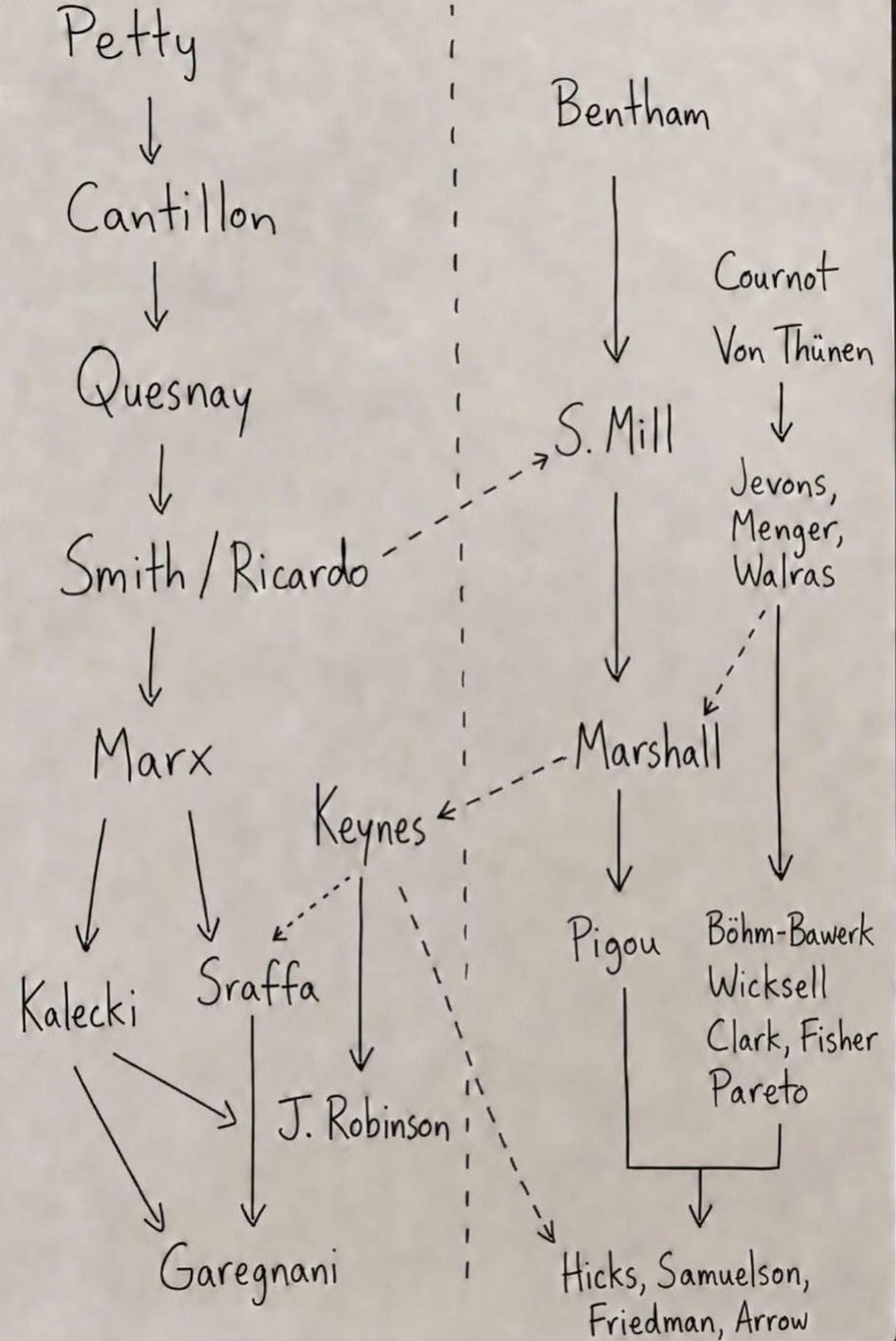
There are some authors who are hard to classify. Keynes is certainly complicated in many ways, since he never completely shed the Marshallian roots of his analysis. However, there are good reasons to put him on the other side of the dividing line. And, as the dotted lines show, there has been plenty of cross-fertilization across the intellectual divide.
The important point for our purposes is that the two main economic traditions — distinguished by their emphasis on individualism and choice, on the one hand, and social reproduction and conflict, on the other, as well as by their alternative theories of value and distribution — can be further divided into four groups when the distinction between historical and theoretical methods is introduced as a separate criterion. Four groups, but only two relevant traditions.
Conclusion
Collins’ four traditions remain useful as a map of recurring themes and intellectual lineages, but his taxonomy sometimes conflates objects of inquiry with modes of explanation. Separating the individualist/structuralist divide from the historical/institutional versus analytical/theoretical distinction clarifies both the continuity between German historicism and Austrian marginalism and the difference between Weber and Marx, among other things.
I am not a sociologist, and would not say this with the same degree of certainty, but Durkheim’s concerns seem to suggest that he would be closer to the Structuralism/conflict side of the table, for example. No need for an additional tradition. Likewise, microinteractionist, to use Collin’s terminology would fit in the individualist side of the table. The point is to distinguish more carefully between what economists, and social scientists in general, analyze and the methods they use to explain it.
References
Coats, A.W. 1988. “The Educational Revolution and the Professionalization of American Economics,” in W.J. Barber (ed.), Breaking the Academic Mould: Economists and American Higher Learning in the Nineteenth Century, Middletown: Wesleyan University Press.
Collins, Randall. 1994. Four Sociological Traditions. New York: Oxford University Press.
Kurz, Heinz. 2016. “German and Austrian schools,” in G. Faccarello and H. Kurz (eds.), Handbook on the History of Economic Analysis, Volume II: Schools of Thought in Economics. Cheltenham: Edward Elgar.
McColloch, William. 2012. Three essays on the role of history and the theory of long-run growth. PhD thesis, University of Utah.